Storing user credentials is one of the most critical security responsibilities in any modern application. For professional developers and product owners, the goal is not just "encryption," but cryptographic resilience—ensuring that even in the event of a full database breach, user passwords remain mathematically unusable to an adversary.
##1. The Hashing Protocol
Unlike symmetric or asymmetric encryption, password storage must utilize a cryptographic hash function. This is a deterministic, one-way function that maps an input of any size to a fixed-size bit string.
- Irreversibility: A hash cannot be "decrypted" because the original data is not preserved within the hash itself.
- Collision Resistance: It must be computationally infeasible to find two different passwords that produce the same hash.
##2. Cryptographic Salting: Preventing Pre-computation
A common vulnerability in basic hashing is the Rainbow Table attack, where attackers use pre-computed tables of hashes for common passwords to instantly "de-hash" data.
###The Solution: Per-User Salting
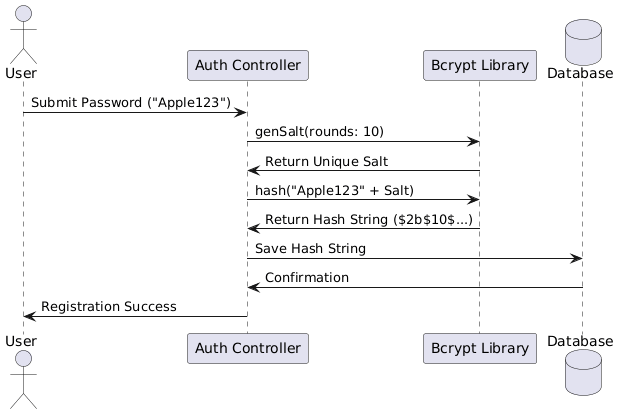
A Salt is a unique, cryptographically strong random string appended to the password before hashing.
- Unique Identity: Each user must have a unique salt.
- Pattern Breaking: If two users have the same password, their unique salts ensure the stored hashes are entirely different.
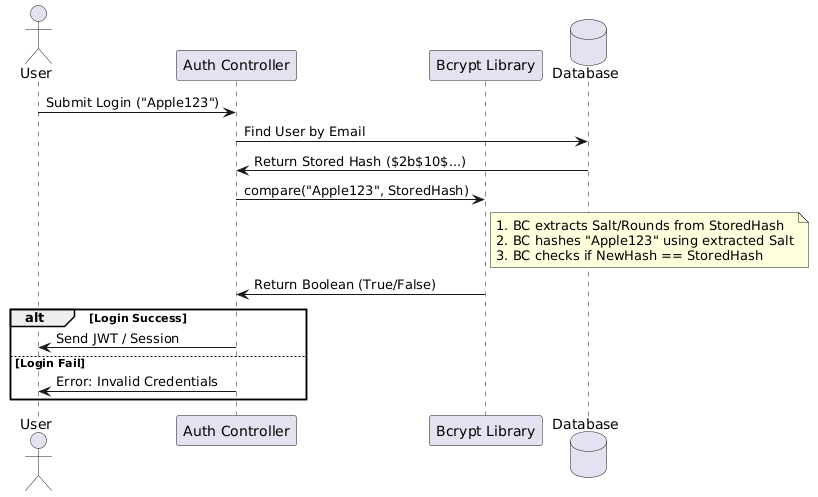
- Storage: Bcrypt handles this by prepending the salt directly to the hash string, eliminating the need for a separate database column.
##3. Why Bcrypt? Adaptive Key Derivation
While SHA-256 is fast, its speed is a liability in password security. An attacker can attempt billions of SHA-256 hashes per second.
Bcrypt is preferred because it is based on the Blowfish cipher and incorporates a Work Factor (Cost).
- Computational Expense: Bcrypt is designed to be CPU-intensive.
- The Cost Factor: As hardware speeds increase (Moore's Law), the cost parameter can be increased to ensure the hashing process remains slow enough to make brute-force attacks economically and temporally unfeasible.
##Hash
##Compare
##4. Implementation Reference (Node.js)
For professional implementations, utilize asynchronous methods to avoid blocking the Event Loop during the CPU-intensive hashing process.