#Understanding Huawei Cloud: From Core Virtualization to Cloud Service Architectures
Modern enterprise IT architecture has evolved far beyond physical server rooms and static configurations. Today, agility and cost optimization hinge on how effectively organizations harness cloud computing.
If you are exploring Huawei Cloud or preparing for architecture design certifications, understanding the foundational mechanics—starting from hypervisors up to managed service delivery models—is essential. In this guide, we break down virtualization fundamentals, Huawei Cloud's operating backbone (FusionSphere), deployment strategies, and the real-world shared responsibility model.
##1. Virtualization vs. Cloud Computing: Defining the Line
Before diving into cloud orchestration, let’s clarify a fundamental distinction that frequently confuses engineers: Virtualization is a core enabling technology; Cloud is a business and service delivery model.
###Virtualization: The Foundational Layer
- What it does: Allows multiple operating systems and virtual machines (VMs) to run concurrently on a single physical host.
- Why it matters: Maximizes server efficiency by eliminating hardware underutilization, carving isolated resource partitions out of compute, memory, and storage.
###Cloud Computing: The Service Engine
- What it does: Packages virtualized pools into on-demand, self-service computing resources accessible over the network.
- Why it matters: Eliminates manual provisioning. Users can request, scale, and decommission infrastructure through APIs and consoles with pay-as-you-go pricing models.
##2. The Cloud OS: Powering Huawei Cloud with FusionSphere
To transform distributed physical hardware into an elastic, shared pool of resources, a modern cloud requires an orchestration platform: a Cloud Operating System.
Huawei Cloud relies on FusionSphere, an enterprise-grade cloud operating system built upon open-source OpenStack architectures.
###Key Capabilities of FusionSphere:
- Unified Resource Pooling: Aggregates compute clusters, software-defined storage (SDS), and software-defined networking (SDN) across multiple physical data centers.
- Open Ecosystem Integration: Built on OpenStack standards, avoiding proprietary lock-in and facilitating hybrid deployments.
- Automated Resource Scheduling: Dynamically balances workloads to guarantee high availability (HA) and disaster recovery (DR).
##3. Cloud Deployment Models
Depending on compliance, security, and operational objectives, Huawei Cloud architecture supports three primary deployment models:
| Deployment Model | Infrastructure Ownership | Key Characteristics |
|---|---|---|
| Private Cloud | Owned and operated by a single enterprise. | Maximum security, sovereign data control, high capital expenditure (CapEx), ideal for government or banking. |
| Public Cloud | Owned and operated by Huawei Cloud. | Scalable on-demand, low initial cost (OpEx), multi-tenant infrastructure open to global businesses. |
| Hybrid Cloud | Combined public and private infrastructure. | Seamless bridge between on-premises and public environments, viewed externally as a cohesive ecosystem. |
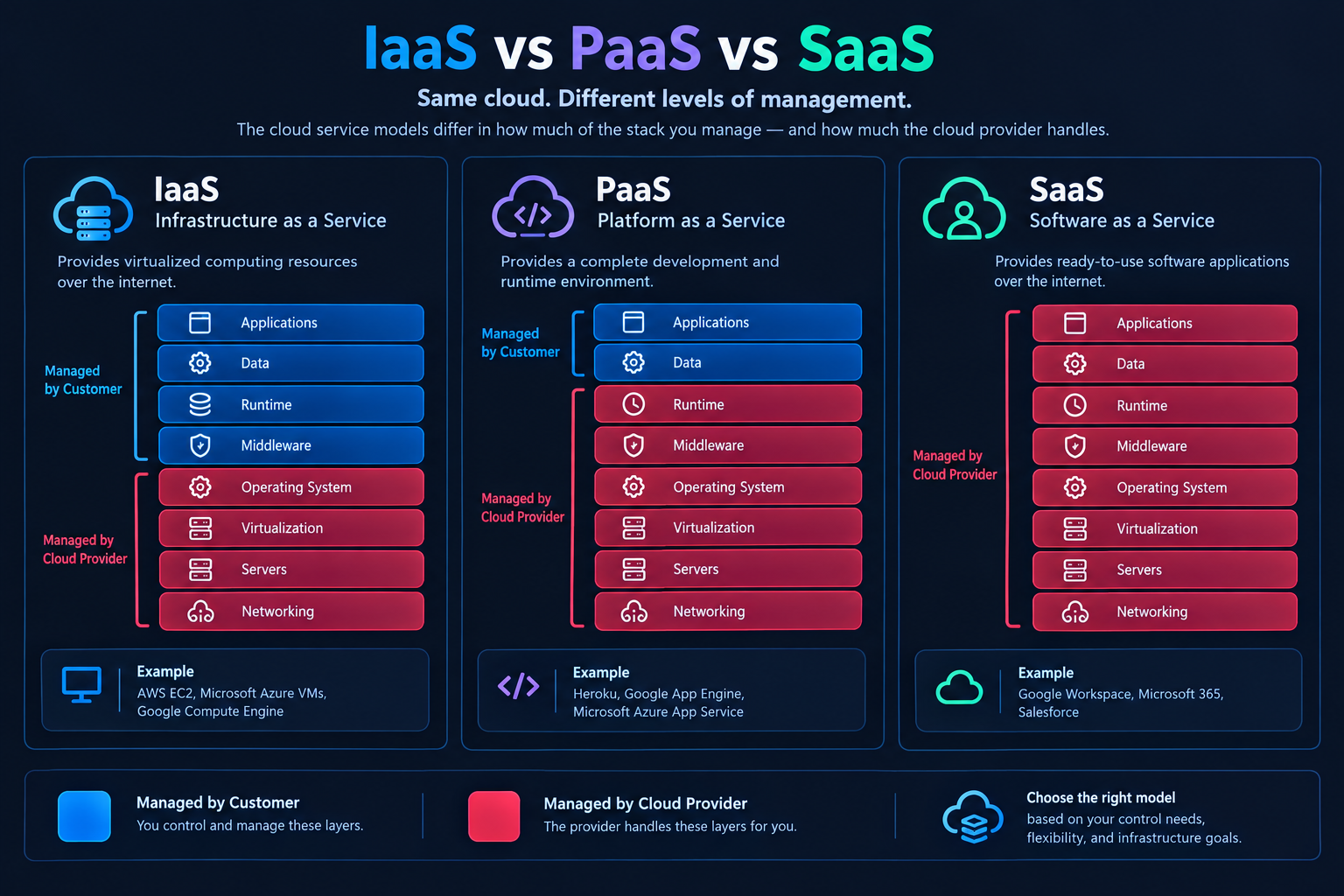
##4. The Cloud Service Spectrum: IaaS, PaaS, and SaaS
Understanding where operational responsibility begins and ends is critical when designing systems on Huawei Cloud.
###A. Infrastructure as a Service (IaaS)
- What you manage: Operating systems, patches, runtime environments, middleware, business data, and application stacks.
- What Huawei Cloud manages: Hypervisors, physical host machines, physical switches, SAN storage, and data center facilities.
- Key Huawei Cloud Examples:
- ECS (Elastic Cloud Server): Scalable compute units configured with your choice of OS (Linux/Windows).
- SFS (Scalable File Service): High-performance, shared network-attached file storage.
###B. Platform as a Service (PaaS)
- What you manage: Only your core applications and proprietary data.
- What Huawei Cloud manages: The OS platform, runtimes, middleware configuration, automated patches, clustering, and storage backends.
- Key Huawei Cloud Examples:
- MRS (MapReduce Service): Enterprise big data platform providing managed Apache Hadoop, Spark, and Flink clusters without OS management overhead.
- CCI (Cloud Container Instance): Serverless container hosting that abstracts node infrastructure.
###C. Software as a Service (SaaS)
- What you manage: Account access, tenant settings, and user inputs.
- What Huawei Cloud manages: The complete software lifecycle—from the server rack to the application logic.
- Key Huawei Cloud Examples:
- Cloud-based OCR (Optical Character Recognition): Ready-to-consume intelligent APIs that extract structured text from image documents without requiring model deployment or cluster configuration.
##Summary: Designing with Intention
Architecting systems on Huawei Cloud requires matching operational complexity with enterprise needs:
- Choose IaaS (ECS, SFS) when you need low-level operating system control and legacy application compatibility.
- Leverage PaaS (MRS) to eliminate operational overhead and accelerate data pipeline deployments.
- Integrate SaaS (Cloud OCR) to consume cognitive and functional workloads directly via API.
By aligning these components with FusionSphere's underlying virtualization, architects can build scalable, fault-tolerant, and cost-efficient cloud infrastructures.